Overview
Welcome to my page all about (ultralight) trekking and hiking! Here I'll be posting new (short) tours, packing lists & information around the topic of traveling on a regular basis. Have fun browsing, Kai
Ultralight Hike
Welcome to my page all about (ultralight) trekking and hiking! Here I'll be posting new (short) tours, packing lists & information around the topic of traveling on a regular basis. Have fun browsing, Kai
Can I even find the way, navigation says hello?
Do I have anything to protect myself from sunburn, wind & snow blindness?
Do I have enough clothes to keep myself warm (both during the day and at night!)
Can I protect myself from wetness? Even if the weather gets worse than expected?
Can I still reach my destination at night if something unforeseen ruins my planning?
Can I (provisionally) repair/patch my gear with minor problems?
Can I provisionally repair/patch myself to at least drag myself to the nearest civilization?
Can I still make fire?
Do I have enough food/water, even if I take a bit longer?
Do I have everything for an overnight stay?
Do I have something for the season-/trip-specific problems? From mosquitoes to an ice axe?
What do I do if things really go wrong?
What would that look like in this terrain? Do I have scenarios for it in which I would know exactly what to do?
Do I have my head with me?!
If you catch yourself answering one of the questions with "no, that probably will not happen/be necessary," you are probably over the limit!
Since it is often said that you need gear X for purpose Y, you can consider whether you could achieve this without the gear or with cheaper gear.
To do this, however, you have to counteract possible miscalculations with knowledge in the preparation phase.
Here are a few examples:
Gear:
Thick inflatable sleeping pad for good sleep anywhere
Skill:
If I want to use a thin Evazote [or BW folding mat] for the same sleeping comfort, I have to pay much more attention than just inflating the mat and throwing it down somewhere.
The choice of campsite in particular is decisive for comfort at night. On a bed of dead needles in a coniferous forest, it is much more comfortable to lie on such a mat than on a concrete surface.
Gear:
Thick sleeping bag all year round
Skill:
Use a light summer sleeping bag in summer, and the thick bag for winter.
Gear:
One sleeping bag model for every month
Skill:
Onion technique: you can not only wear different layers of clothing on top of each other, but also bundle yourself into several sleeping bags in winter.
Gear:
LineLocks for guying out the tarp/tent
Skill:
Take a topsail sheet bend for the lines de.wikipedia.org/wiki/Topsegelschotstek
Gear:
Thin Evazote mat on concrete
Skill:
How do I take a sleeping pill... joking aside, again a mistake in site selection that takes away comfort at night.
Is that not dangerous?
Since you engage with the trip beforehand, the risk potential is no higher than on normal hikes. As a rule, expanding your comfort zone is a longer process.
Whoever treats UL gear the same way as their BW gear, crashing through all thorn bushes near the trail, whoever deliberately sits on their 5 g alcohol stove, is beyond help. But for those who handle it responsibly, I have so far not noticed any difference in durability. I have never broken a UL backpack or a normal backpack under normal use.
A lot can be eliminated through careful planning. How long do I have to haul water between sources. Are there towns nearby for stocking up on water [cemeteries are usually also open on Sundays] / buying food when crossing through cities.
This interests me, where do I start?
After you have removed more and more items you do not need from your backpack tour after tour, you can venture into new investments, or start right away with MYOG .
It is best to start with the heaviest items; these are referred to as the Big 3. Swapping them out
One of the best-known UL principles is 343, three for three, and it means bringing the weight of the following items (the Big Three) below 3 kg for three-season use:
1. Shelter
A double-wall tent can easily weigh 3-5 kg, each peg 40-60 g, and it adds up quickly. Double-wall means double the weight due to the 2 layers of material.
A single-wall tent weighs on average between 1-2 kg, as the inner tent material is saved. In return, there is more condensation from breath.
With some tent models, the poles can also be replaced by trekking poles, another multi-use item that can save weight.
A tarp is one of the lightest shelters, but forgives setup mistakes the least. While a large tarp still forgives setup mistakes, things look different with a poncho tarp.
2. Sleep system
The sleep system consists of ground insulation through a sleeping pad & a sleeping bag or quilt (sleeping bag without a back section). A down sleeping bag insulates better on average than a sleeping bag with synthetic fill, but is also more susceptible to moisture. Because when damp, the down can clump together and the insulating effect is lost from that moment on. With synthetic fibers, the insulating ability is only somewhat reduced.
3. Backpack
A small tent and a small sleep system need less volume in the backpack, allowing a smaller, lighter backpack to be used. This is the 3rd step, because the backpack must fit your gear. Many UL backpacks no longer have a frame or hip belt for weight reasons. These are already at their limit with just a few kilos. With my most-worn backpack (~470 g), this is for example at >=12 kg. If you have even more weight on your back, better settle for a reasonably light backpack (1.1-1.5 kg) that still has a carrying frame and hip belt to distribute the load better.
And now?
Once the Big 3 have been reduced, the next heaviest item would be up, which is usually the cooking set. For some, it is already enough to take only one pot instead of 3. Others want to go further and start cooking only in their mug.
Keep experimenting and draw a conclusion from every trip. To do this, categorize your gear afterwards into 3 categories:
Since thoughts in the Bushcraft/survival/trekking forums among users increasingly revolve around ultralight gear, I wanted to explain some of the UL approaches and share some basic knowledge I have learned over the past few years. Swapping your existing gear for lighter alternatives does not necessarily have to be the expensive route. There are cheaper and more sensible ways to reach the goal.
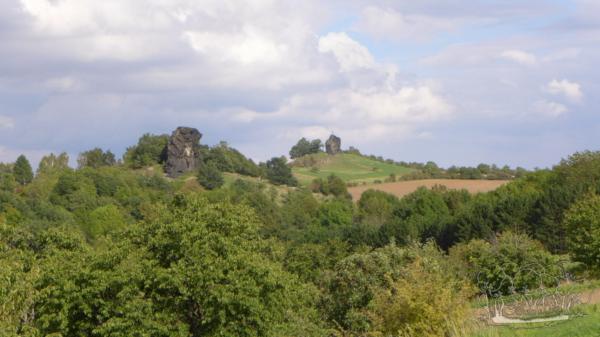
Bimbi and I were out in the eastern Harz this month to hike the Devil's Wall Trail from Blankenburg to Ballenstedt. Somehow, though, we seem to have strayed a bit off course.
 weiterlesen...
After a long time, it is finally time: my web presence on the topics of travel / (ultralight) trekking is finally going online.
Stay tuned!
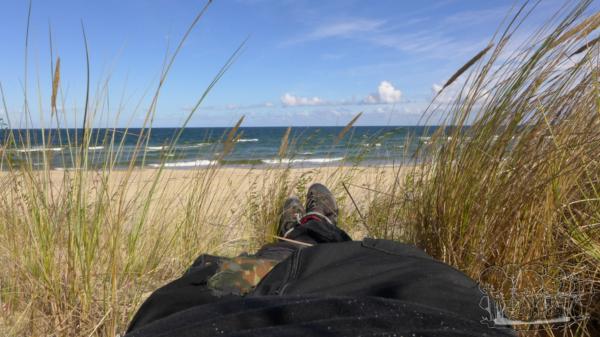
Today I'm finally back in Germany, returning from a short trip to Poland.
Sun, beach, bunker complexes, met some dearly beloved crazies again and had a great time.
 weiterlesen...


