To be able to bake on the trail, you need two cooking pots that fit inside one another and have no non-stick coating. In addition to the pots, you need an adjustable stove with an output of about 100 watts. A stove with 100 watts takes about 25 minutes to bring 20°C cold water to a boil. This output is achieved, for example, with four tea lights.
There are two different approaches to baking on the trail:
On the one hand, there is dry baking. This is comparable to baking in an oven. The inner pot ideally rests on the outer pot. There is no air between the two pots. The outer pot is strongly heated by the stove and transfers this heat via the metal to the inner pot. The inner pot heats the baked goods from three sides: from below through the bottom and from all sides through the rim of the pot.
The air temperature in the pots is over two hundred degrees Celsius. This high temperature is not only sufficient for the ingredients to bind firmly together (about 70°C), but is also hot enough to caramelize the sugar (important for forming a crust). The temperature for this must be above 130°C. The baking time for dry baking is about one third longer than the baking time for steam baking. Therefore, more fuel is also needed here. You have to be careful with dry baking.
If the outer pot cannot transfer its heat to the inner pot quickly enough, it becomes very hot.
At high temperatures, the metal first discolors, then the bottom becomes wavy and finally brittle. That is why I now avoid dry baking and prefer to use steam baking.
On the other hand, there is steam baking. Here, the outer – slightly larger – pot contains some water and a spacer for the second – slightly smaller – pot so that it does not touch the water. The spacer can be made of wire, stones, or other materials.
With this method, a cycle forms. The water absorbs the heat from the stove, evaporates, and condenses on the inner cooking pot. There it releases its thermal energy again and drips back into the pot as water. Since a closed cycle forms this way, a small amount of water (50-100ml) is sufficient for baking.
The temperature in the inner cooking pot is around 100°C. This temperature is sufficient for baking and melting cheese. However, no crust forms here because the temperature is unfortunately not high enough for that. But this has the great advantage that nothing burns either. This way, food can also be reheated the next morning without the risk of burning. Furthermore, the likelihood of damaging the pot is much lower.
Here are a few examples of what this can look like:
(since my two pots fit into each other with the rims resting on each other, I do not need an additional spacer)
Initially, I bring the water to a boil at full flame and then reduce it to a minimum with a simmer ring. With this method, my alcohol consumption for steam baking is between 15 and 20 milliliters per meal.
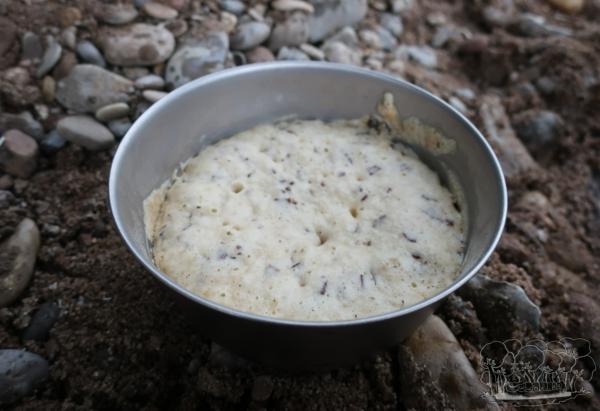
For many, coffee and cake are part of everyday life, but on the trail this is usually limited to the former. This article will be about cake prepared using the dry or steam baking method.
 weiterlesen...
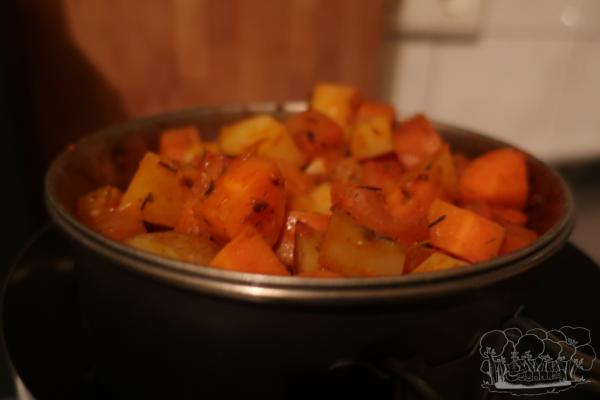
While on a longer hike, you will quickly notice that the food becomes monotonous very quickly. Most main dishes rely on noodles, rice, and couscous. To escape this monotony, it is a good idea to prepare oven vegetables once in a while. Since fresh vegetables are used for this, it is best to prepare this meal right after restocking your provisions.
 weiterlesen...
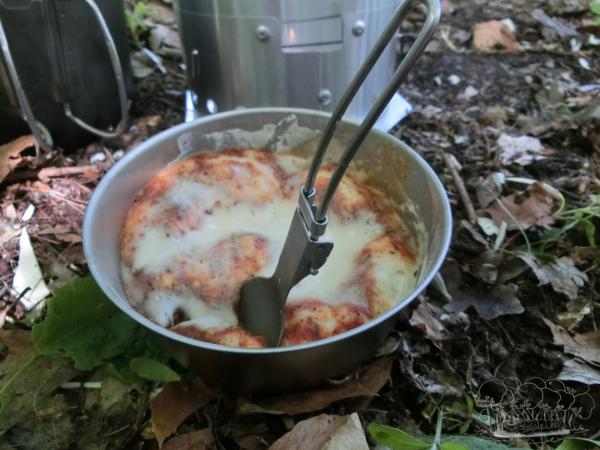
Pizza is one of the most popular and oldest fast food dishes. Fast food dishes have a very high energy density and are therefore well suited for the trail. Since my cravings on longer trips fluctuate between fast food and bell peppers, this recipe is ideal.
 weiterlesen...


